
Florida Construction News staff writer
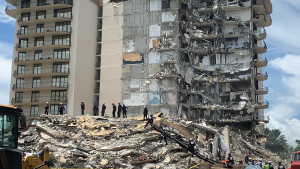
The catastrophic collapse of the Champlain Towers South condominium in Surfside began weeks before the building fell, according to technical findings released last week by the National Institute of Standards and Technology.
Click this link to view a video presentation of the findings.
After a five-year investigation, NIST’s National Construction Safety Team concluded that the June 24, 2021, disaster that killed 98 people was triggered by the failure of two connections between garage columns and the pool deck in early June 2021. Those initial failures caused cracks to spread and structural loads to shift throughout the pool deck over the following three weeks, ultimately leading to the building’s collapse.
Investigators found that the failed column connections transferred their loads to nearby slab-column connections that were not strong enough to support them, setting off a chain reaction that culminated in the collapse.
“When building structures are designed and built to required codes and standards, they have margins against failure, meaning they should be able to support much more load than they are expected to bear,” said Judith Mitrani-Reiser, co-lead of the investigation. “In the case of Champlain Towers South, however, these margins against failure were too narrow from the start.”The 12-story beachfront condominium was built in 1981 in Surfside, north of Miami Beach. According to investigators, the collapse likely progressed after failures spread through portions of the pool deck and street-level parking structure. The pool deck eventually broke away from critical supports, damaging connections that supported the tower’s middle section. The failure then propagated through the building’s middle and eastern sections.
“The low margins against failure were primarily caused by two factors,” said Glenn Bell, the investigation’s other co-lead. “First, severe and widespread deviations in the building’s original structural design from the codes and standards of the day, but also some limitations in those codes and standards. And second, deviations in the building’s construction from the design drawings.”
Investigators said additional loads added to the structure over its lifetime, including modifications to the pool deck, further reduced the building’s ability to withstand failure. Long-term corrosion also contributed to the deterioration of structural components.The team ruled out several potential causes, including vibrations from nearby construction projects, foundation failure, sinkholes, settling, hurricane or storm surge effects, explosions, and accidental overloading related to a roof project underway at the time of the collapse.
NIST launched its investigation days after the tragedy and evaluated roughly two dozen possible collapse scenarios. The effort included materials testing, geotechnical studies, interviews with survivors and others familiar with the building, computer modeling, and analyses of physical evidence and historical records.
Investigators said the unusual nature of the collapse — occurring after the building had stood for four decades without an obvious immediate trigger — made the case particularly challenging.
The agency will now prepare its final report, which will include detailed evidence, test results and modeling data supporting its conclusions. The report is also expected to include recommendations for changes to building codes, standards and industry practices aimed at improving building safety and preventing similar tragedies in the future.
