
Special Report
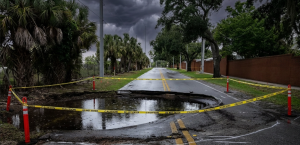
Two Central Florida sinkholes put road repair procedures under scrutiny in 2026, with Lake County relying on an emergency procurement exemption and Orange County using test borings to assess ground conditions. The projects illustrate how contracting decisions and engineering verification can influence infrastructure recovery.
What does the sinkhole formation process in Florida look like?
Sinkholes present a recurring hazard in Florida. These ground failures can damage roads, buildings and utility infrastructure. According to GeoStabilization International, a geohazard mitigation firm, sinkholes are the visible result of an underground void where ground support has been lost. Heavy rain, continued soil erosion, deteriorating utilities, drainage problems and poorly compacted backfill can contribute to collapses.
Understanding how groundwater causes sinkholes is important because much of Florida sits on porous limestone, a carbonate rock that groundwater can gradually dissolve. Over time, this process creates underground cracks, cavities and drainage pathways that can weaken the soil. The resulting ground collapse can damage roads, buildings, pipelines and utility corridors.
Sinkholes can also be caused by construction-related water movement. In Southeast Winter Haven, a tunnel formed beneath Intermodal Drive during the construction of a retention pond. The tunnel connected two ponds, and a siphoning effect caused water to flow underground and erode soil beneath the roadway.
How are sinkholes repaired?
Before repairs begin, engineers need to assess the damaged area and investigate the ground. Sinkhole investigation methods for roads may include geological assessments, subsurface testing, and checks for voids or unstable soil.
Repair methods may vary with the size and cause of the failure. Work can involve excavating unstable material, replacing it with suitable fill, or using drilled-injection methods to fill voids and strengthen the surrounding ground. The repair plan must address the underlying loss of support and the visible damage to the roadway.
Sinkhole-related road closures in Lake and Orange counties created challenges for local officials and engineers.
Emergency procurement for Lake County’s $2.53 million repair
A depression appeared on Empire Church Road near Groveland on February 2, 2026. “This has understandably been a frustrating situation for nearby residents,” Lake County Board of County Commissioners Chairman Leslie Campione said. After confirming the depression was a sinkhole, Lake County cited the area’s underlying limestone geology as a factor. The collapse measured approximately 90 feet wide, 200 feet long and 50 feet deep.
The Lake County Board of County Commissioners approved Resolution 2026-26 on February 24, classifying the incident as an “act of God” under the statutory provision cited in the county agenda. The determination exempted the repair work from competitive solicitation, according to ClickOrlando.
The county identified Estep Construction Inc. as the lowest bidder at $2,533,576.44. The funding package included a $533,577 appropriation to the Infrastructure Sales Tax Fund and two $1 million budget transfers. The road reopened in May 2026 after emergency repair work.
Test borings to verify ground conditions in Orange County
A sinkhole opened on North Wymore Road in Maitland on May 15, 2026, forcing a road closure during repairs. Crews filled the hole, and engineers drilled test borings to evaluate soil compaction and check ground conditions before the roadway was rebuilt.
The borings extended about 80 to 100 feet underground. Engineers also used concrete to provide additional ground support before crews reconstructed the road base and paved the surface.
Orange County eventually repaved roughly 1,100 linear feet between Hope Road and Brightwater Circle, expanding the initial estimate of around 150 feet to address additional worn asphalt. The road reopened in July, following several weeks of repair work. Orange County said its Roads and Drainage crew’s “skill, teamwork and determination made this reopening possible.” Officials have not publicly established a cause for the Wymore Road sinkhole.
What can Florida’s construction industry learn from these projects?
Emergency procurement can reduce delays from ordinary solicitation procedures. Florida Statutes § 337.11 addresses contracting authority and emergency repairs for state transportation facilities, so public owners must establish the applicable legal basis for their project.
The two sinkhole repair projects demonstrate that subsurface investigation, stabilization, compaction verification and roadway reconstruction address different stages of a repair. That means the answer to how long sinkholes take to repair depends on site conditions, investigation findings, procurement and the scope of restoration.
The projects also show the importance of aligning procurement decisions with a documented engineering scope. Faster contracting can speed up repairs, and subsurface testing helps verify ground conditions before road construction.
Sinkhole repairs demand urgency and evidence. Lake and Orange counties’ experiences show how procurement decisions and subsurface testing affect the path from road closure to reopening. Emergency contracting can expedite the process, and engineering verification helps ensure ground stability.
